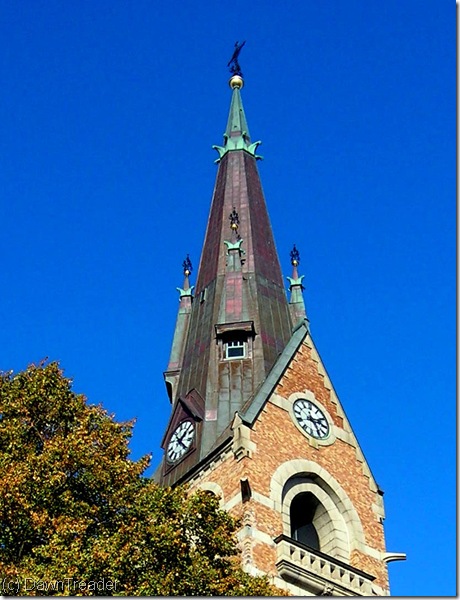
PLEASE NOTE

This blog goes on under a different name and new web address from January 2011. Please follow me...

Beyond the Lone Islands

http://dawntreader-island2.blogspot.com

Showing posts with label church. Show all posts

Friday, 15 October 2010

Permission To Move Hell

DSCN1764-1

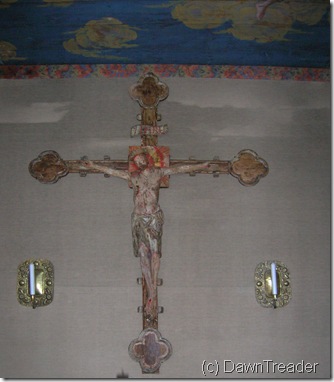
Looking through my pictures of the inside of the old church at the museum park (see Unexpected Flashbacks), I also spotted this one (above). I have thought of posting about it before, but never got round to it.

In old churches with painted ceilings you often find Heavenly pictures, with clouds and angels. You can see an example of that in one of the photos in yesterday’s post, over the pulpit.

Sometimes, at the back of the church, like here over the organ balcony, they also included illustrations of Judgment Day and/or Hell.

In the village where I lived as a child, we had that kind of church. It was a stone church, not a wooden one. But it had a painted ceiling including both Heaven and Hell. Now my family weren’t churchgoers, so I didn’t get to (or have to) look at those pictures very often. I’m not sure I even ever took any particular notice of Hell (which just like in the photo above was situated over the organ balcony) until in junior high school I got a teacher who came from the same parish, and who loved to tell a story about it. It took place before we kids were even born. I don’t remember all the details now, but in the mid 20th century, the church was to go through a major restoration. I think the building was to be made longer, and the tower added. Anyway, it involved the old painted ceiling in a way which caused headlines in the newspapers: “Will X (=name of the parish) be allowed to move Hell?” And after long – and I presume heated! – discussions in the episcopate council or whereever such things are decided, the answer was presented in new headlines: “X allowed to move Hell”. 

No small achievement for a country village church!

But of course the Church has always believed in the right to stir up both Heaven and Hell:

And when Jesus had cried out again in a loud voice, he gave up his spirit. At that moment the curtain of the temple was torn in two from top to bottom. The earth shook and the rocks split. The tombs broke open and the bodies of many holy people who had died were raised to life.

(Matthew 27:50-52, NIV)


The Apostles’ Creed

I believe in God, the Father almighty,
creator of heaven and earth.
I believe in Jesus Christ, his only Son, our Lord,
who was conceived by the Holy Spirit,
born of the Virgin Mary,
suffered under Pontius Pilate,
was crucified, died, and was buried;
he descended into hell.
On the third day he rose again;
he ascended into heaven,
he is seated at the right hand of the Father,
and he will come to judge the living and the dead.
I believe in the Holy Spirit,
the holy catholic Church,
the communion of saints,
the forgiveness of sins,
the resurrection of the body,
and the life everlasting.
Amen.

(Common Worship translation, Church of England 2000)

The earliest appearance of the full text we know as the Apostles' Creed is from around 710. Shorter versions go back much further.

---

PS. Yes, I’m moving this post up from earlier in the week. Since I also had another post that day, I think some of the regular readers perhaps missed this one. (If hell can be moved once, why not twice?)

Tuesday, 12 October 2010

Unexpected Flashbacks

Yesterday, I had a surprise, since suddenly on my Blogger reading list, a very familiar-looking photo appeared. But I had not posted it! Not recently, anyway… However, I knew that I had posted another photo of the same building only the day before. For a second or two, I was very bewildered indeed!

Then my brain started working again. I realized what blog the picture was on: Write With Pictures. A blog to which I have given permission to use my pictures. I also realized that in my recent Picture Book post (Museum Church), I had linked back to an older post (17th century church) where this photo was included. So the whole thing was not at all as strange as it first seemed!

The Write With PicturesMonday Meme’ means sharing “what memories that come to mind” when looking at the picture. Hm! Since it was my own photo, and I had revisited the place only two days ago, of course it brought back memories!

So I wrote down what went through my head. And after having done that, I decided to go back here and repeat some of it, and add a couple of more photos. And words.

♥-♥-♥

I think it was two years ago one year ago that I last went inside, one day when the door was open. Coming in from the bright light outside, it was so dark in there that I had very little idea what I was taking photos of. But I did take some flash photos. Not until I was back home, getting the photos up on the computer screen, could I see the details.

Now this reminds me of two things:

1. Some doors are not always open.
We have to find them at the right moment.

DSCN9225-1 
When I was there last, the door was closed.

 DSCN7834-1 
When I took this picture, the door was open.

2. Sometimes we do not really see things clearly until in retrospect.

DSCN1748-1 
Collection of old keys inside the porch; and a box, in which visitors can leave a contribution to the maintenance of the church. I think it is probably supposed to be St Peter on the pillar. Or maybe that’s just how my mind wanders because of the keys in the background. It was to Peter that Jesus said: “on this rock I will build my church” and “I will give you the keys to the kingdom of heaven” (Matthew 16:18-19)

DSCN1763-1

“In the beginning was the Word, and the Word was with God, and the Word was God.” John 1:1

DSCN1760

“The true light that gives light to every man was coming into the world. He was in the world, and though the world was made through him, the world would not recognize him.” (John 1:9-10)

Sunday, 30 May 2010

Wholly 2

DSCN6203-1

In my previous post on this sculpture, Wholly, I mentioned that from one angle (which I had missed to take a picture of) you can also see a church tower behind it.  Sandra then said in a comment “see if you can capture the church through the wholly” - so I went back and tried. It is not possible to actually see the church through the sculpture. But here is the view with the church tower in the background.

19Consequently, you are no longer foreigners and aliens, but fellow citizens with God's people and members of God's household, 20built on the foundation of the apostles and prophets, with Christ Jesus himself as the chief cornerstone. 21In him the whole building is joined together and rises to become a holy temple in the Lord. 22And in him you too are being built together to become a dwelling in which God lives by his Spirit.

St Paul’s Letter to the Ephesians (chapter 2)

Sunday, 4 April 2010

An Easter Sermon

DSCN2964-2

I think it was in the late 1980s or early 1990s that  one year for the first time I came to follow the whole series of Easter services in a church belonging to the Lutheran Church of Sweden (which was a state church until the year 2000). This experience increased my understanding of how following ritual liturgy can serve as a sermon in itself; because they also bothered to include explanations of the symbolism.  

It has not been very many times since then that I have actually been to every one of these services over the same Easter Weekend. But the connection lingers in my mind, whether I actually go or not.

On Maundy Thursday [1], there is an evening service, with the Holy Communion (also called The Lord’s Supper). This is in memory of the last night Jesus spent with his disciples, and their meal together, which took place “on the first day of the Feast of the Unleavened bread, when it was customary to sacrifice the Passover lamb” (Mark 14:12).

Passover refers to the Jewish celebration in memory of when Moses led the Israelites out of Egypt. The last of the plagues that fell upon the Egyptians (because Pharaoh refused to let the Israelites go) was the death of the first born in every family. But the Israelites were told to slaughter a lamb instead, and put some of the blood on the doorframe of their house. And doing so, the plague passed them by. (Exodus 12:17-27) That was “the old covenant”. [2]

While they were eating, Jesus took bread, gave thanks and broke it, and gave it to his disciples, saying: “Take and eat; this is my body.” Then he took the cup, gave thanks and offered it to them, saying, “Drink from it, all of you. This is my blood of the covenant, which is poured out for many for the forgiveness of sins.” (Matthew 26:27-28)

This time, in Christian belief… A once-and-for-all covenant.

At the end of the Maundy Thursday communion service, the altar table is “undressed”. All decorations, including the table cloths, are ceremoniously removed, and it stands there naked.

[1] The word Maundy comes from the Latin "mandatum", meaning command, and relates to John 13:34 where Jesus tells his disciples - in connection with him washing their feet before they sat down to eat (i.e. doing the job of a servant): 
"A new commandment I give you: Love one another, as I have loved you" . This origin of “maundy” I did not know until I read about it in Ginny’s blog Let Your Light Shine the other day. Thank you Ginny!

[2] A covenant is a type of contract in which one party makes a promise to the other to do or not do some action.
DSCN1269B-1

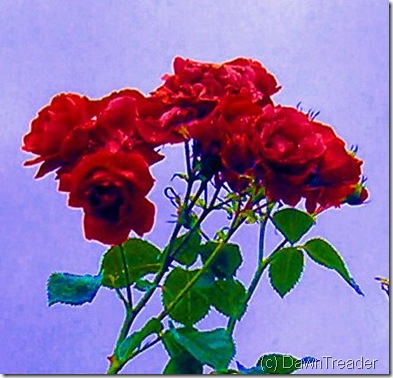
On Good Friday (which in Sweden we call Long Friday), the altar in the church is still bare, except for one vase with five red roses in it. The five roses represent the five wounds from the crucifixion: the piercing of the hands and the feet, and then the spear stuck in his side to check that Jesus was truly dead before they took him down from the cross.

During the Good Friday service, no music is played. All hymns are sung a cappella. And no candles lit.

“From the sixth hour until the ninth hour darkness came over all the land. About the ninth hour, Jesus cried out in a loud voice --- My God, my God, why have you forsaken me?” (Matthew 27:45-46)

These words refer to the first verse of Psalm 22 in the Old Testament. This psalm is said to be a pretty accurate description of what happens in a crucifixion. Among other things, piercing of hands and feet is mentioned. Crucifixion, however, was not something practised by the Jews, not even in the days when Jesus lived and died – that’s why they handed him over to the Romans.
 DSCN1760

On Easter Eve, there is a Midnight service, starting at 11.30 PM. Before entering the church, everyone gathers in the parish hall next door, and everyone gets a candle. With candles still unlit, all walk into the church, which lies in darkness. Words from the Book of Genesis are read:

In the beginning God created the heavens and the earth. Now the earth was formless and empty, darkness was over the surface of the deep, and the Spirit of God was hovering over the waters.
(Genesis 1:1)

Vows of baptism are renewed (the Lutheran church practises child baptism) and everyone walks up to a big candle and light their own candles from that – or pass on the fire from one person to another.

Then all the lights are turned on; the altar table is laid with fresh linen; flowers (daffodils, which we call “Easter lilies”) are brought in; music is added; and the Holy Communion (symbolising the New Covenant) is celebrated.

At the end of the service (about half an hour past midnight), all walk out of the church together, candles still burning (representing carrying the light out into the world); greeting each other outside with the words: “Christ is risen! – Indeed, He is risen!”

“On the first day of the week, very early in the morning, the women --- went to the tomb. They found the stone rolled away from the tomb, but when they entered, they did not find the body of the Lord Jesus.” (Luke 24:1-2)

DSCN2973-1

“Why do you look for the the living among the dead? He is not here; he has risen!” (Luke 24:5)

The Easter Sunday service later on Sunday is a jubilant resurrection celebration, in full daylight, with lots of flowers and music. ♫ ♪ ♫

On Easter Monday there is also a church service, with the Holy Communion, and the texts on this day are about Jesus showing himself to his disciples after the resurrection. The Gospel of John tells us how Mary Magdalene met Jesus near the tomb. Matthew points out that there was another Mary with her. Luke says they were three women. Anyway, the male disciples found it hard to believe them at first. But later the same day Jesus appeared to some of the men as well. The common thread in all the stories is that each person at first did not recognize him, or did not dare believe that it was really he. But then he said something, or did something, that convinced them.

Jesus said to her, “Mary”. She turned toward him and cried out in Aramaic: “Rabboni"!” (which means Teacher). (John 20:16)

When he was at the table with them, he took bread, gave thanks, broke it and began to give it to them. Then their eyes were opened, and they recognized him… (Luke 24:30-31)

---

The pictures chosen to illustrate this post are from various places and none of them from the church mentioned in the first paragraph.

Sunday, 21 March 2010

At Least And At Last

At Least today did not just feel like a repetition of yesterday.

And At Last there are patches of bare ground large enough to make it possible to actually stretch one's legs a bit when going for a walk. (And oh, do mine need stretching...!)


Can't say that the day seemed to start out very well, at first. I woke up too early, still tired but unable to go back to sleep. I got up reluctantly, took my medicines and had a bit of breakfast (but did not get dressed); then turned on the computer to check if there were any emails  - and there were, so that was nice - but then tiredness hit me again... So I went back to bed, intending to read, but fell asleep, and next time I woke up it was 10 o'clock.

Then I surprised myself, because within half an hour I had a shower, got dressed and set off to go to church - which I had not planned! I had not even checked the ads in the paper the day before; only did now just before I left. I haven't been to any church for months.


I ended up today in the oldest one in town, from the 17th century. It is beautifully decorated inside*, but with terribly uncomfortable benches (not agreeing well with my neck). However, they follow a 'high church' liturgy which means you get to stand up every five minutes or so. A bit confusing when you're out of practice (what? again? but we just sat down!); but with difficulties sitting too long in the same position, I have come to regard it as a good thing. The 'high church' profile also means that the service almost always includes the holy communion. Which I also regard as a good thing.

Water colour by Lars Lerin

Another good thing about this church is that I don't know a whole lot of people there. I do have a friend who sings in the choir (classical music kind of choir, and they were singing today), and occasionally I might run into one or two other aquaintances. But I don't get attacked by people jumping to conclusions like a/ I'm a lost sheep come back and intending to come every Sunday hereafter, or b/ asking me if I'm in town for a visit and what do I work with these days (I never moved away, and I've been in early retirement for six years). Sorry, getting a bit ironic there... But sometimes I actually prefer the more anonymous atmosphere.

In the liturgical year, it's Lady Day or the Feast of Annunciation. I'm learning the English terms for it as I write... Well, that's 25 March really, i.e. 9 months before the date we celebrate the Birth of Christ. But that's what the sermon was about. Otherwise usually not a whole lot of fuss made about Mary (mother of Jesus) in the Protestant churches.

I'm not going to try to recapitulate the whole of the sermon here (don't think I could, anyway), but the text was about how Mary, after she finds herself pregnant, goes to see Elizabeth, mother-to-be of John the Baptist, who is a bit further along in her pregnancy. And Elizabeth says to Mary: "As soon as the sound of your greeting reached my ears, the baby in my womb leaped for joy." (Luke 1:44) Now, the clergyman (male) who was preaching took a somewhat unusual angle on this, focusing on the  sensation of a kick in the stomach for other reasons - which even a man can feel. The image has its limitations, I suppose, but somehow it still lingers with me:
The ability of a Word to give you a Kick...

* Some day in the summer season, I will go back as blogging tourist and take pictures. Not the right occasion to do that today.

Friday, 12 March 2010

Church(es)


Over the past few months, one of my Friendly Followers and Bloglings (GB) has posted a number of pictures of different kinds of church buildings in New Zealand. Somehow, his last church post (from the Anglican cathedral in Napier) led my thoughts back to a picture I had pinned up on my notice board for many years in my previous flat.
I had some trouble finding it now but at last I did. (Not on the internet, but in one of my drawers.) It's a postcard of an oil painting by a Swedish artist, Olle Olsson-Hagalund (1904-1972), entitled "Girl with plaster churches". As you can see, he depicts a girl having a bit of trouble choosing between a number of different models of churches for sale at a market.

There is no Wikipedia article in English for this artist, but if you click on his name above, the link will transport you to a Swedish website where you can have a look at some more of his paintings. His style is somewhat naivistic, very colourful, and marked by a lot of detail. He often also framed his paintings himself and then also painted the frame in his own very original style, to become part of the picture. (There are some examples of that too on that website.)

I saw a large collection of his paintings "live" at an exhibition back in the 1990s, and I think it's the only temporary art exhibition that I ever went back to three times (in a month or two) because I liked it so much. I also remember some of the things I learned about him - like the fact that when he went to his studio to paint, he used to put on his best suit! It was a feast for him to paint; and the joy of it often shows in his pictures. The painting of the girl with the churches was also included in that exhibition.

When I had that card put up on my wall, I combined it with a quote from an interview with the English writer Adrian Plass. His most famous book is probably The Sacred Diary of Adrian Plass Aged 37¾ (from 1987). (Ha! I only just now learned the full title of it - the Swedish translation leaves out the 37¾! I wonder why - I absolutely love that!) There are also a couple of sequels to that first one; but the first one was especially hilarious because the first time you read it you're not prepared (or at least I wasn't) so it takes you by surprise.
It is a very humourus, fictional satire of Christian life - "including such moments as trying to move a paperclip by faith" (sentence quoted from the Wiki article).

I find the book quite unique in that Plass manages to make fun of things without ever getting really mean or bitter about them. Part of the secret might be that he lends his own name to the main character and narrator of the story. This underlines that he is not just making fun of "other people" but of himself. And somehow he manages to catch the struggles, the stupid extremes, and the grains of true faith and love in the midst of it, "all in one". (I've been in churches very much like his fictional church; pretty much every scene in the book is familiar to me.)

This blog post is all digressions so far. I wonder if I'll ever be able to get round to some sort of point?

Getting back to that little piece of a quote that used to sit on my notice board, together with the Girl With Churches picture: That interview with Adrian Plass was published in a Swedish magazine, in 1996, i.e. some years after The Sacred Diary. In the interview, Adrian mentions that through the years, he has come to realize that he really belongs to two churches. One consists of the Christian friends who he is actually spending time with, talking to, sharing his life with. That "church" has no written rules, no real structure, and no building - but nonetheless, those people are his church. But then, at the same time, there is also the church that he formally belongs to (which does have rules, and structure, and a building to meet in); and going to services there he sees as a sort of public confession of his faith and of belonging to the Christian Church as such.

Now why did I have this picture, and this quote on my wall? Maybe after my ramblings here you can more or less guess. Through my life, I have "collected" a number of churches myself. Sometimes, the choice has come naturally, because of facts of life like moving from one town to another. Sometimes, there have been choices a little more complicated. But basically, around the time that I went to that art exhibition and read that interview back in the 90s, I found myself in a position similar to what Adrian describes. In my heart, there was one church of friends. But those friends did not all go to the same building to express their faith; and in some ways I found myself (like the girl in  the picture) embracing a whole "set" of different churches (with the same basic beliefs, but some different ways of expressing them).

Nowadays, with pain problems and things like that in the picture for me as well, I don't go regularly to any church. And when I do go, I have become a bit of a "browser". But there is still a church - or the church - in my heart. And over the last year, that church has kept growing faster than for a very long time. Because (somewhat to my amazement) I keep finding "church-building" ingredients everywhere in this cyberspace: wonderings, thoughtfulness, questions, doubts, faith, discussions, prayers, longing, worship, wisdom, laughter, tears, sharing and caring! Thank you.

~♥~♥~♥~

“It's rubbish to tell people that we can easily dispose of life's huge questions once and for all. We all have times when we're bad-tempered or we grumble. We all have doubts. What's wrong with saying that?”
Adrian Plass

LinkWithin

Blog Widget by LinkWithin