PLEASE NOTE

This blog goes on under a different name and new web address from January 2011. Please follow me...

Beyond the Lone Islands

http://dawntreader-island2.blogspot.com

Showing posts with label Bible. Show all posts

Monday, 19 July 2010

Quotation of the Week (29/2010)

The page of life that was spread out before me seemed dull and commonplace, only because I had not fathomed its deeper import.
~Nathanael Hawthorne~

DSCN7384-1
Wooden sculpture by Uno Axelsson

Come to me , all you who are weary and burdened, and I will give you rest.
~Matthew 11:28~

Most of Uno Axelsson’s wooden sculptures are of animals, but this one is entitled “My Hands”, and includes the Bible quote from Matthew 11.

See more of his sculptures in yesterday’s post, and there will be even more to come.

Sunday, 30 May 2010

Wholly 2

DSCN6203-1

In my previous post on this sculpture, Wholly, I mentioned that from one angle (which I had missed to take a picture of) you can also see a church tower behind it.  Sandra then said in a comment “see if you can capture the church through the wholly” - so I went back and tried. It is not possible to actually see the church through the sculpture. But here is the view with the church tower in the background.

19Consequently, you are no longer foreigners and aliens, but fellow citizens with God's people and members of God's household, 20built on the foundation of the apostles and prophets, with Christ Jesus himself as the chief cornerstone. 21In him the whole building is joined together and rises to become a holy temple in the Lord. 22And in him you too are being built together to become a dwelling in which God lives by his Spirit.

St Paul’s Letter to the Ephesians (chapter 2)

Thursday, 8 April 2010

Old Things We Don't Know

At the top of my sidebar (as you might have noticed) I have an automatic quotation gadget, over which I have no control. Today's quotation, however, happened to fit in rather well with my last post (Ancient Times), so I thought I'd nail it down in a post of its own: 
There's nothing new under the sun*, but there are lots of old things we don't know.
Ambrose Bierce (1842-1914)
 *This in turn is a Biblical quote:
What has been will be again, what has been done will be done again; *there is nothing new under the sun.
(Ecclesiastes 1:9)

Wednesday, 7 April 2010

Ancient Times


"Time it was, and what a time it was, it was..."
~Paul Simon, Bookends~

In my post yesterday I wondered a bit "on the side" why, in the Book of Genesis, it says "and there was evening, and there was morning", instead of the other way round. (Did God work nightshift?) I did have it at the back of my head, that the Jewish ideas about when the day started were or are different from how we look at it today... So I checked it up. And thought I might as well share my findings:

In the era before the modern clock, a specific hour of the night could not be precisely known, whereas an hour of the day was easily determined by sighting the location of the sun. This meant that the day had to be reckoned either from the beginning of night or the beginning of day.

Both ways of looking at it existed in Biblical times. The Egyptians considered the day to start at sunrise. The Babylonians considered it to begin with the night. (The Israelites were under Egyptian influence for a while, but Babylonian later.)

In Jewish tradition, the day begins with the onset of night (the appearance of the stars), followed by the morning (which technically begins with the appearance of the North Star). Or, sunset and sunrise respectively.

So the Jewish Sabbath begins on Friday night and ends with the appearance of the stars on Saturday night; and the same is true for the major holidays.

Beginning the day with the night is also considered a metaphor of life itself. Life begins in the darkness of the womb, then bursts into the brightness of the light and eventually settles into the darkness of the grave, which, in turn, is followed by a new dawn in the world-to-come.

In the beginning God created the heavens and the earth. Now the earth was formless and empty, darkness was over the surface of the deep, and the Spirit of God was hovering over the waters. And God said: "Let there be light," and there was light. God saw that the light was good, and he separated the light from the darkness. God called the light "day" and the darkness he called "night". And there was evening, and there was morning - the first day. (Genesis 1:1-5)


Sources:
http://www.aish.com
http://www.webexhibits.org/calendars/calendar-jewish.html
+ a Swedish Encyclopedia of the Bible

Sunday, 4 April 2010

An Easter Sermon

DSCN2964-2

I think it was in the late 1980s or early 1990s that  one year for the first time I came to follow the whole series of Easter services in a church belonging to the Lutheran Church of Sweden (which was a state church until the year 2000). This experience increased my understanding of how following ritual liturgy can serve as a sermon in itself; because they also bothered to include explanations of the symbolism.  

It has not been very many times since then that I have actually been to every one of these services over the same Easter Weekend. But the connection lingers in my mind, whether I actually go or not.

On Maundy Thursday [1], there is an evening service, with the Holy Communion (also called The Lord’s Supper). This is in memory of the last night Jesus spent with his disciples, and their meal together, which took place “on the first day of the Feast of the Unleavened bread, when it was customary to sacrifice the Passover lamb” (Mark 14:12).

Passover refers to the Jewish celebration in memory of when Moses led the Israelites out of Egypt. The last of the plagues that fell upon the Egyptians (because Pharaoh refused to let the Israelites go) was the death of the first born in every family. But the Israelites were told to slaughter a lamb instead, and put some of the blood on the doorframe of their house. And doing so, the plague passed them by. (Exodus 12:17-27) That was “the old covenant”. [2]

While they were eating, Jesus took bread, gave thanks and broke it, and gave it to his disciples, saying: “Take and eat; this is my body.” Then he took the cup, gave thanks and offered it to them, saying, “Drink from it, all of you. This is my blood of the covenant, which is poured out for many for the forgiveness of sins.” (Matthew 26:27-28)

This time, in Christian belief… A once-and-for-all covenant.

At the end of the Maundy Thursday communion service, the altar table is “undressed”. All decorations, including the table cloths, are ceremoniously removed, and it stands there naked.

[1] The word Maundy comes from the Latin "mandatum", meaning command, and relates to John 13:34 where Jesus tells his disciples - in connection with him washing their feet before they sat down to eat (i.e. doing the job of a servant): 
"A new commandment I give you: Love one another, as I have loved you" . This origin of “maundy” I did not know until I read about it in Ginny’s blog Let Your Light Shine the other day. Thank you Ginny!

[2] A covenant is a type of contract in which one party makes a promise to the other to do or not do some action.
DSCN1269B-1

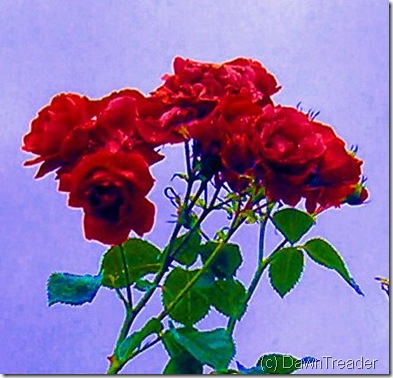
On Good Friday (which in Sweden we call Long Friday), the altar in the church is still bare, except for one vase with five red roses in it. The five roses represent the five wounds from the crucifixion: the piercing of the hands and the feet, and then the spear stuck in his side to check that Jesus was truly dead before they took him down from the cross.

During the Good Friday service, no music is played. All hymns are sung a cappella. And no candles lit.

“From the sixth hour until the ninth hour darkness came over all the land. About the ninth hour, Jesus cried out in a loud voice --- My God, my God, why have you forsaken me?” (Matthew 27:45-46)

These words refer to the first verse of Psalm 22 in the Old Testament. This psalm is said to be a pretty accurate description of what happens in a crucifixion. Among other things, piercing of hands and feet is mentioned. Crucifixion, however, was not something practised by the Jews, not even in the days when Jesus lived and died – that’s why they handed him over to the Romans.
 DSCN1760

On Easter Eve, there is a Midnight service, starting at 11.30 PM. Before entering the church, everyone gathers in the parish hall next door, and everyone gets a candle. With candles still unlit, all walk into the church, which lies in darkness. Words from the Book of Genesis are read:

In the beginning God created the heavens and the earth. Now the earth was formless and empty, darkness was over the surface of the deep, and the Spirit of God was hovering over the waters.
(Genesis 1:1)

Vows of baptism are renewed (the Lutheran church practises child baptism) and everyone walks up to a big candle and light their own candles from that – or pass on the fire from one person to another.

Then all the lights are turned on; the altar table is laid with fresh linen; flowers (daffodils, which we call “Easter lilies”) are brought in; music is added; and the Holy Communion (symbolising the New Covenant) is celebrated.

At the end of the service (about half an hour past midnight), all walk out of the church together, candles still burning (representing carrying the light out into the world); greeting each other outside with the words: “Christ is risen! – Indeed, He is risen!”

“On the first day of the week, very early in the morning, the women --- went to the tomb. They found the stone rolled away from the tomb, but when they entered, they did not find the body of the Lord Jesus.” (Luke 24:1-2)

DSCN2973-1

“Why do you look for the the living among the dead? He is not here; he has risen!” (Luke 24:5)

The Easter Sunday service later on Sunday is a jubilant resurrection celebration, in full daylight, with lots of flowers and music. ♫ ♪ ♫

On Easter Monday there is also a church service, with the Holy Communion, and the texts on this day are about Jesus showing himself to his disciples after the resurrection. The Gospel of John tells us how Mary Magdalene met Jesus near the tomb. Matthew points out that there was another Mary with her. Luke says they were three women. Anyway, the male disciples found it hard to believe them at first. But later the same day Jesus appeared to some of the men as well. The common thread in all the stories is that each person at first did not recognize him, or did not dare believe that it was really he. But then he said something, or did something, that convinced them.

Jesus said to her, “Mary”. She turned toward him and cried out in Aramaic: “Rabboni"!” (which means Teacher). (John 20:16)

When he was at the table with them, he took bread, gave thanks, broke it and began to give it to them. Then their eyes were opened, and they recognized him… (Luke 24:30-31)

---

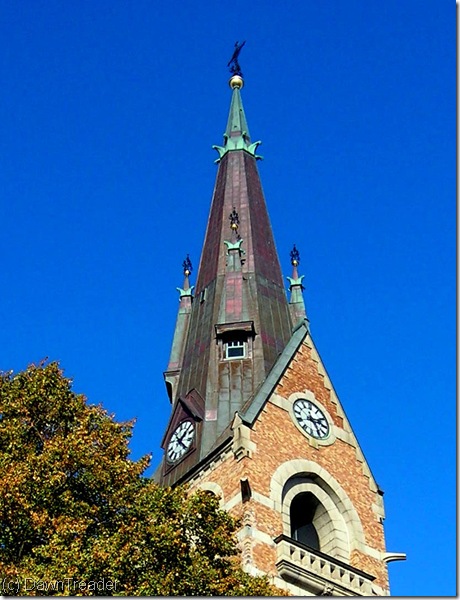
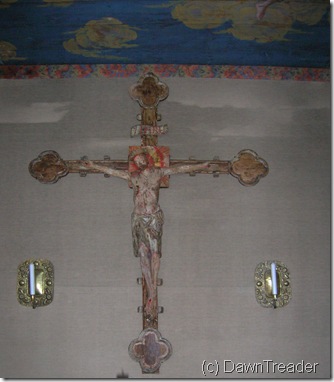
The pictures chosen to illustrate this post are from various places and none of them from the church mentioned in the first paragraph.

Wednesday, 27 January 2010

Snow, Wind, Fire and Definitions


If the photo seems familiar, you may have seen it before in a post entitled Fire and Ice back in December 2009, about a Christmas Market and the making of an ice sculpture.

Today, I'm looking out of my windows at a snowstorm outside, and feeling lucky that this happens to be a day when I don't have to go out. (Traffic warnings have been given, around here defined as a No 1 warning, on a scale of 1-3, with 3 as the worst.)

My thoughts, however, are circling more around some recently read posts at other people's blogs.

Yesterday evening, I was reading a post at {Simply}Heather's Blog, entitled Furious or Cleansing Winds. I have to confess: I don't always find Heather's thoughts all that "simple". Sometimes they raise protests within me, while at the same time I partly agree, which can be very confusing. (That is not meant as criticism. The best writers are often the thought-provoking ones.) Sometimes, like yesterday, I find myself wondering whether 20 years or so ago, at another stage of my life, my reactions would have been the same, or different. I keep turning thoughts like that over, and don't always really reach a conclusion. I am the same, yet different; because my life has changed a lot since then. (What is it they say? Every cell in the human body is replaced and renewed within a period of seven years...)

Part of Heather's post had to do with the word "religious" used as a label. I get her meaning, and yet when I look back through my own life, I find that I no longer react quite the same way to that word as I used to. I quote my comment:

Words are tricky sometimes.

When I was younger, I think I had that same definition of 'religious'. And if someone asked me if I was religious, I would automatically say: No, but I am a Christian.

Today, I think I would say: 'Define religious!' before I accept or reject the epithet.

Because the primary definition of the word is simply: "having or showing belief in and reverence for God or a deity" (Free Online Dictionary) or "relating to or manifesting faithful devotion to an acknowledged ultimate reality or deity" (Merriam-Webster).

I would still want to add that not just any deity will do for me. But the word in itself (religious), for some reason, has become a lot more neutral to me. I'm not sure why. Possibly just because I have had more time to think about defintions...

It might also have something to do with the fact that these days, most of the rules and restrictions that I find myself forced to follow are set by my own body.

Anyway: Then, this morning, I read a post by Don at Musings and Misc. Thoughts, entitled I've Been Burned. No attempt to sum it up would do it justice so I really recommend taking the time to read it in full. But it has to do with getting burned by life, but at the same time learning the difference between "consuming" vs "refining" fire. Which in turn led my thoughts back to Heather's title - "Furious or Cleansing Winds".

The Bible is full of thought-provoking contrasts like that. However much you try, you can never quite pin God down and define him. You just end up first with Himself teasingly defining Himself as "I am who I am" (Exodus 3:14); and then, in the New Testament, his Son nailed to the cross, and put in a sealed and guarded tomb - and still breaking loose! You might say, not only did Jesus refuse to obey the rules, he also refused to be defined as dead...

Monday, 5 October 2009

Quotation of the Week (41/09)

Who of you by worrying can add a single hour to his life?
--- For the pagans run after all these things, and your heavenly Father knows that you need them. But seek first his kingdom and his righteousness, and all these things will be given to you as well. Therefore do not worry about tomorrow, for tomorrow will worry about itself. Each day has enough trouble of its own.
The Gospel of Matthew 6:27, 32-34 (NIV)

LinkWithin

Blog Widget by LinkWithin