PLEASE NOTE

This blog goes on under a different name and new web address from January 2011. Please follow me...

Beyond the Lone Islands

http://dawntreader-island2.blogspot.com

Showing posts with label religion. Show all posts

Friday, 17 December 2010

Christmas Horses

Advent Calendar / 17 December

DSCN0717-1

… Really?! … Well, the first reaction would be “neigh”… (“nej” meaning “no” in Swedish!) … but on second thought …

These ponies I found in the Christmas market last weekend, and children could go for a ride around the town square.

“In the good old days”, when people went by sleigh to church early on Christmas morning… the sleigh was of course drawn by horses.

image
Photo from sverigesradio.se

I’ve mentioned before that pastry cutters for Christmas gingerbread biscuits come in all kinds of shapes – including the pig, and the yule goat. Many years ago on holiday in the province Dalarna in central Sweden, I also bought pastry cutters in the shape of horses.

imageThis picture I found on the internet
(easier than finding my own cutters)

The province Dalarna is famous for their wooden horses (in the same shape as the pastry cutters), colourfully decorated with a special kind of folk art, kurbits.

DSCN0749
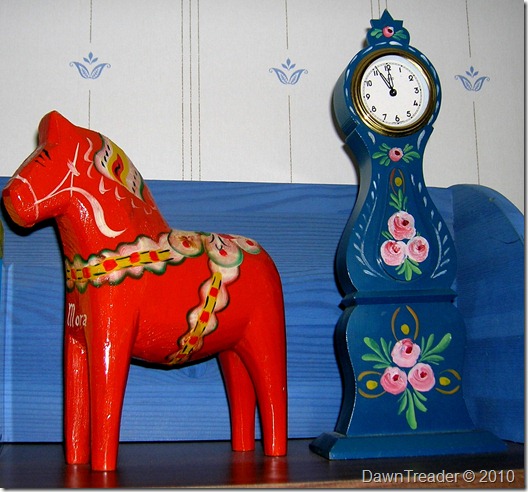
My Dala-horse, and a model of a grandfather type of clock 
from the same area; both painted in the “kurbits” style.
I mentioned in connection with Lucia, that the male participants in the Lucia processions, called “star boys”, are associated with the first Christian martyr, St Stephen. One of the songs often sung by the boys in the Lucia procession talks of St Stephen (“Staffan”, in Swedish) as an ostler or stable boy, taking care of his “five horses”, “in the light of the star”. The origins of this song are said to go back way further than the Lucia traditions and are based on a legend that places Stephen as a servant of King Herod around the birth of Jesus (rather than as the first martyr of the early church after Jesus’ death ~35 AD): seeing the star of Bethlehem he told Herod about it, and thereby aroused the king’s anger.

image

A medieval church ceiling painting of St Stephen and his horses
(picture from Swedish Wikipedia) ~ 1200 AD

The horse, just like the pig and the goat, also belongs in pre-Christian Scandinavian traditions. The Old Norse god Odin’s horse Sleipnir was said to have eight feet. He could run through the air as well as on the ground, and the stories also tell of him being ridden down into the Underworld to the realm of the dead (reigned by queen Hel). Horses were also used for sacrifices.

Looking at the medieval painting above, I doubt it is quite a coincidence that it can be seen either as two horses, or as one horse with eight feet and two heads, one pointing up, and one down. It strikes me that the painting was probably meant to recall ideas of descending into hell and rising into heaven, borrowing the imagery from the old religion. (A “revelation” that only dawned on me just now. I had no idea whatsoever when I started writing this post that from the ponies at the Christmas market I would end up with references to old Sleipnir…!)

Friday, 15 October 2010

Permission To Move Hell

DSCN1764-1

Looking through my pictures of the inside of the old church at the museum park (see Unexpected Flashbacks), I also spotted this one (above). I have thought of posting about it before, but never got round to it.

In old churches with painted ceilings you often find Heavenly pictures, with clouds and angels. You can see an example of that in one of the photos in yesterday’s post, over the pulpit.

Sometimes, at the back of the church, like here over the organ balcony, they also included illustrations of Judgment Day and/or Hell.

In the village where I lived as a child, we had that kind of church. It was a stone church, not a wooden one. But it had a painted ceiling including both Heaven and Hell. Now my family weren’t churchgoers, so I didn’t get to (or have to) look at those pictures very often. I’m not sure I even ever took any particular notice of Hell (which just like in the photo above was situated over the organ balcony) until in junior high school I got a teacher who came from the same parish, and who loved to tell a story about it. It took place before we kids were even born. I don’t remember all the details now, but in the mid 20th century, the church was to go through a major restoration. I think the building was to be made longer, and the tower added. Anyway, it involved the old painted ceiling in a way which caused headlines in the newspapers: “Will X (=name of the parish) be allowed to move Hell?” And after long – and I presume heated! – discussions in the episcopate council or whereever such things are decided, the answer was presented in new headlines: “X allowed to move Hell”. 

No small achievement for a country village church!

But of course the Church has always believed in the right to stir up both Heaven and Hell:

And when Jesus had cried out again in a loud voice, he gave up his spirit. At that moment the curtain of the temple was torn in two from top to bottom. The earth shook and the rocks split. The tombs broke open and the bodies of many holy people who had died were raised to life.

(Matthew 27:50-52, NIV)


The Apostles’ Creed

I believe in God, the Father almighty,
creator of heaven and earth.
I believe in Jesus Christ, his only Son, our Lord,
who was conceived by the Holy Spirit,
born of the Virgin Mary,
suffered under Pontius Pilate,
was crucified, died, and was buried;
he descended into hell.
On the third day he rose again;
he ascended into heaven,
he is seated at the right hand of the Father,
and he will come to judge the living and the dead.
I believe in the Holy Spirit,
the holy catholic Church,
the communion of saints,
the forgiveness of sins,
the resurrection of the body,
and the life everlasting.
Amen.

(Common Worship translation, Church of England 2000)

The earliest appearance of the full text we know as the Apostles' Creed is from around 710. Shorter versions go back much further.

---

PS. Yes, I’m moving this post up from earlier in the week. Since I also had another post that day, I think some of the regular readers perhaps missed this one. (If hell can be moved once, why not twice?)

Tuesday, 8 June 2010

Portrait

 2010 06 04_Hani collage_2

DSCN6318-2

Hani by Anne-Karin Furunes

Another piece of art which is included in the Sculpture Festival.

Anne-Karin Furunes is a Norwegian artist known for using perforation technique. Her works are based on photographs, but consist of a perforated black or white canvas (or sheet of metal). Most frequently the image is an extreme close-up of a face. As one approaches the image, it begins to fade and ultimately disappear.

This picture has been up on that wall for a while – perhaps a year? I never heard anyone comment on it. To me it is kind of thought provoking that the place they have chosen for it is on the back wall of our public swimming hall.

---

In my childhood, we had some immigrants in my school and neighbourhood, but they all came from other European countries. Most of them from Finland, but also some from Eastern and Southern Europe. There were some language difficulties, but they did not look or dress different. I can only remember one case where religion became an issue. During my first few school years in the 60s we went to school also on Saturdays. Then one day we got a Jewish boy to the class, who could not attend school on Saturdays because that for him was the Sabbath. I don’t remember how they solved it. Extra homework I suppose…

Our society has become a bit more international since then. Women wearing headdresses of Muslim kind for example is no longer an uncommon sight in our streets. It is still an issue in some jobs though, whether employees should be allowed to wear veils or turbans.

A few years ago when I had to go to the emergency room at the hospital, one of the doctors that took care of me was wearing a veil like the one in the picture. I think that was the first time I saw any medical staff wearing it. I have to say in that particular situation it did not matter to me what anyone looked like, only if they could help!

Language can be a real problem though. We get a lot of foreign doctors. I’m sure most of them are excellent at their job, and we should be grateful that they want to come and work here (or else we should find ourselves –even more- short of doctors). Nonetheless, it is problematic when doctor and patient can’t understand what the other is saying. My last experience of that was my visit to the eye clinic recently. There was this doctor with a foreign accent, and he kept asking me something over and over which I just completely failed to understand because of his pronunciation. I think we both felt equally stupid. Luckily there was another doctor who was there on some kind of internship – she stepped in and acted as “interpreter”…

I have no idea where I’m going with all this – nowhere at all really. Looking at the portrait just sent my thoughts out on a ramble…

Probably means it’s a good piece of artwork!

Wednesday, 17 March 2010

St Patrick's Day


Having become a Blog World Citizen, new days of Celebration are added all the time! Like today: Saint Patrick's Day. Inspired by the scrapbooking fair I went to on Sunday (and some of the things I bought) I made the card above, with this week's theme at the Soaring Through the World in Pictures blog in mind: Touch of Luck. For the photo, I put the card with one of my potted plants, a red-leaved variety of Oxalis triangularis.

Saint Patrick (circa 387–461 AD) is patron saint of Ireland because he brought Christianity to the Irish. Legend says he taught them about the Christian concept of the Trinity by referring to the shamrock, a three-leaved clover, using this as symbol of the 'three divine persons in the one God'. Legend also credits Patrick with banishing snakes from the island. Evidence however suggests that Ireland never had snakes (or at least very few of them). But the snake did belong in Celtic symbolism, representing magic, druid wisdom, and the cycle of life/rebirth (because it sheds its skin). While in Christian symbolism, the serpent is a symbol of temptation, deceit and evil (Satan). So the banishing of the snake by St Patrick was most likely symbolic of getting rid of the old pagan religion.

Wednesday, 27 January 2010

Snow, Wind, Fire and Definitions


If the photo seems familiar, you may have seen it before in a post entitled Fire and Ice back in December 2009, about a Christmas Market and the making of an ice sculpture.

Today, I'm looking out of my windows at a snowstorm outside, and feeling lucky that this happens to be a day when I don't have to go out. (Traffic warnings have been given, around here defined as a No 1 warning, on a scale of 1-3, with 3 as the worst.)

My thoughts, however, are circling more around some recently read posts at other people's blogs.

Yesterday evening, I was reading a post at {Simply}Heather's Blog, entitled Furious or Cleansing Winds. I have to confess: I don't always find Heather's thoughts all that "simple". Sometimes they raise protests within me, while at the same time I partly agree, which can be very confusing. (That is not meant as criticism. The best writers are often the thought-provoking ones.) Sometimes, like yesterday, I find myself wondering whether 20 years or so ago, at another stage of my life, my reactions would have been the same, or different. I keep turning thoughts like that over, and don't always really reach a conclusion. I am the same, yet different; because my life has changed a lot since then. (What is it they say? Every cell in the human body is replaced and renewed within a period of seven years...)

Part of Heather's post had to do with the word "religious" used as a label. I get her meaning, and yet when I look back through my own life, I find that I no longer react quite the same way to that word as I used to. I quote my comment:

Words are tricky sometimes.

When I was younger, I think I had that same definition of 'religious'. And if someone asked me if I was religious, I would automatically say: No, but I am a Christian.

Today, I think I would say: 'Define religious!' before I accept or reject the epithet.

Because the primary definition of the word is simply: "having or showing belief in and reverence for God or a deity" (Free Online Dictionary) or "relating to or manifesting faithful devotion to an acknowledged ultimate reality or deity" (Merriam-Webster).

I would still want to add that not just any deity will do for me. But the word in itself (religious), for some reason, has become a lot more neutral to me. I'm not sure why. Possibly just because I have had more time to think about defintions...

It might also have something to do with the fact that these days, most of the rules and restrictions that I find myself forced to follow are set by my own body.

Anyway: Then, this morning, I read a post by Don at Musings and Misc. Thoughts, entitled I've Been Burned. No attempt to sum it up would do it justice so I really recommend taking the time to read it in full. But it has to do with getting burned by life, but at the same time learning the difference between "consuming" vs "refining" fire. Which in turn led my thoughts back to Heather's title - "Furious or Cleansing Winds".

The Bible is full of thought-provoking contrasts like that. However much you try, you can never quite pin God down and define him. You just end up first with Himself teasingly defining Himself as "I am who I am" (Exodus 3:14); and then, in the New Testament, his Son nailed to the cross, and put in a sealed and guarded tomb - and still breaking loose! You might say, not only did Jesus refuse to obey the rules, he also refused to be defined as dead...

Thursday, 14 January 2010

Passing Through Stone


Above is a collage of winter and summer pictures of a sculpture.
I posted pictures of it back in July 2009 too. My comment then was: "This is another one of those sculptures that may work as a magic door, if you dare look through it instead of just circling around it." (The perspective you get when looking through the stone is different from when looking past it from a distance, and it is added to by reflections, since the inside of the hole has been polished so that it works like a mirror.)

I'm generally fascinated by (stories about) "magic openings". And I know this is something I share with people all over the world, through thousands of years back in history...

Today, a post at the Japanese blog Camera Works Blogger by Tsutomu Otsuka caught my attention. It is entitled Relationship Making and Breaking Stone, and tells of


a shrine with "a giant stone 1.5m high and 3m wide. It is said that the power of the gods flows into the round hole on the top side of the stone. Pass through the hole in the stone from front to back to break off a bad relationship. And then pass through from back to front to make a good one."


This triggered a memory at the back of my brain - something I read a couple of years ago about a stone on some island off the coast of Scotland, to which similar traditions were connected. At first I couldn't remember what island, or why on earth I had been reading about it, but it came back to me...

It was in connection with my "Harry Potter research" that I came across it. I had been reading up on and comparing Old Norse and Celtic traditions; and then, in connection with "unbreakable vows" (there is one of those made in Harry Potter and the Half-Blood Prince), I happened to come across a web page about The Odin Stone on the Orkney Islands. Once I remembered enough to know what to put into the search engine, I managed to find the website again now.

The Odin Stone, or Stone o' Odin, was a "holed monolith" (thought to have been erected around 3000BC) that stood in a field by the Standing Stones o' Stenness; until it was destroyed in 1814 by an incomer to the island, by the name of Captain W. Mackay.


The stone was "approximately 2.5 metres (8 feet) high with a breadth of about one metre (3.5 feet)" and "played a major part in a number of Orkney wedding traditions".


"...the man being on one side and the woman on the other, they took hold of each other's right hand through the hole, and there swore to be constant and faithful to each other. This ceremony was held so very sacred in those times that the person who dared to break the engagement made here was counted infamous, and excluded all society" 
"It was likewise usual, when a husband and wife could not agree, that they both came to the Kirk of Stainhouse (Stenness), and after entering into the kirk the one went out at the south and the other at the north door, by which they were holden legally divorced, and free to make another choice." - Although in this case, the "divorce" took place in the church of Stenness, a short distance away from the Standing Stones, was this a later development? Perhaps an attempt by the church to draw the Orcadians away from their heathen practices? 
I just find it interesting, that in so different parts of the world, a giant stone with a natural hole in it should be connected to "relationship making and breaking"...

(The modern Swedish sculpture, as far as I know, has really nothing to do with this, except in my mind.)

LinkWithin

Blog Widget by LinkWithin